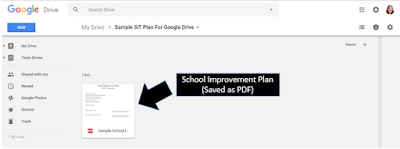
Huge shout-out to Matt Miller, author of Ditch That Textbook (seriously, if you're not reading his blog - you're missing out), for teaching me this handy trick at MACUL 2017! This is a game-changer!
Given the number of websites that promise to make our lives easier, I am generally pretty dubious of such claims. Having said that, this website is amazing! Not only did it simplify the task of making online content printer-ready, it does it with the click of a button. I am a huge fan of this resource.
Within classrooms, iPads and other tablets are becoming
increasingly prevalent. There are thousands of blog pots and websites
dedicated to how these tools can be used to engage students and enhance
learning. Teachers are finding new ways to incorporate these tools each
and every day. But what do they do with these tablets when they’re not in
use? Follow the directions below to create an inexpensive storage rack for your
classroom tablets.
Assemble Materials:
5 Sheets of "Readi-Board" Foam Board (available at
the Dollar Tree)
Hot Glue Gun (with Glue)
Pencil
Ruler / Yard Stick
Razor Blade (sharp, fresh blade)
The First Cut:
Cut one sheet of foam board into two - 10" x 30"
pieces.
Inside Cover Piece:
Use one of the 10" x 30" pieces and measure the
panels as shone above. You will need to trim an inch off the length (but
measure panels - as the actual length of the board can vary)
Use straight edge (yard stick) to guide blade and score
sheet between offset marks. Be careful
not to cut through bottom paper.
Bend the sheet back to break along cut lines and peel away
center foam strip.
With the strip removed, you will be able to fold the panels
into shape.
This will nestle into the outside cover piece, in order to
create a sturdier structure.
Outside Cover Piece:
Use the other 10" x 30" piece and measure the
panels as shone above. You will need to trim an inch off the length (but
measure panels - as the actual length of the board can vary)
Use straight edge (yard stick) to guide blade and score
sheet between offset marks. Just like
before, be careful not to cut through bottom paper.
Bend the sheet back to break along cut lines and peel away
center foam strip.
With the strip removed, you will be able to fold the panels
into shape.
This Inside Cover (made earlier) will nestle into this
outside cover piece, in order to create a sturdier structure.
Glue the Inner & Outer Covers Together
Use the hot-glue to adhere the Inside Cover to the Outside
Cover piece.
You will glue all three sides. We have not created a bottom
(or back) at this time.
Making Shelves:
Cut 4 sheets into panels (as shown above).
You will use 10 - 8.25" x 20" as shelves.
Fold 9 of the shelving pieces over on top of itself
and glue. Each shelf will consist of a dual layer of foam board.
Reserve one of the remaining shelving pieces for the back of
the case (cut to size - 8 1/4" x 9 13/16"). The back will be only one
foam board in thickness and may need to be trimmed in order to secure a tight
fit.
Putting It All Together:
Glue each shelf in place using the hot glue (make certain
that they are attached as strait as possible) at 1" increments.
The Finished Product:
Not only is this project practical, it is also a reminder of how much easier the Metric System can make our lives (lesson learned for next time)... And that's another pint-sized PD.